Monday, January 17, 2011
Google, Facebook and Yahoo Ready IPv6 Test
Several of the Internet's most popular Web sites - including Facebook, Google and Yahoo - have agreed to participate in the first global-scale trial of IPv6, the long-anticipated upgrade to the Internet's main communications protocol known as IPv4.
The trial — dubbed "World IPv6 Day" — requires participants to support native IPv6 traffic on their main Web sites on June 8, 2011.
Leading content delivery networks Akamai and Limelight Networks also committed to the IPv6 trial, which is being sponsored by the Internet Society. IPv6 is a necessary upgrade because the Internet is running out of IP addresses using the 30-year-old IPv4 standard.
Less than 5% of IPv4 addresses are left unallocated to the regional Internet registries, which in turn dole them out to network operators. Experts say the free pool of IPv4 addresses will be depleted in a matter of weeks.
IPv4 uses 32-bit addresses and can support 4.3 billion devices connected directly to the Internet. IPv6, on the other hand, uses 128-bit addresses and supports a virtually unlimited number of devices - 2 to the 128th power.
The day-long IPv6 trial is a critical development for content providers such as Google and Facebook, which until now have been supporting IPv6 at separate, dedicated Web addresses rather than on their main traffic-heavy Web sites. Google, for example, says it will enable IPv6 on its main Web sites - including www.google.com and www.youtube.com - for World IPv6 Day.
The event is also a big deal for Yahoo, which has been reluctant to support IPv6 because of concerns about using a DNS whitelisting approach like Google's, which provides IPv6 content only to users with known end-to-end IPv6 connectivity.
"Participating in World IPv6 Day will allow us to obtain real-life data that we can use to ensure a seamless user experience as we transition to IPv6," said Adam Bechtel, vice president of Yahoo's Infrastructure Group, in a statement. "We welcome this opportunity to collaborate with the technical community and provide leadership in addressing the scaling challenges facing the Internet."
Monday, January 10, 2011
Facebook virus spreads via photo album chat messages
A new social networking worm in the vein of Koobface is currently doing the rounds.
This one actively infects your computer with malware instead of simply tricking you into taking surveys and passing on messages to other users.
The link in his Facebook chat from a friend pointed to an app.facebook.com/CENSORED link. Typically when you go to a Facebook app page it prompts you to add the application and grant it permission to post on your behalf or read your profile data. The scary part about this one is that it immediately prompts you to download a "FacebookPhotos#####.exe" file with no prompting or clicking required. The screen reads "Photo has been moved. This photo has been moved to other location. To view this photo click View Photo." If your computer has not already downloaded the malware, the "View Photo" button will download the virus for you.
It is really unfortunate that Facebook scams are moving back towards spreading malware. Fortunately, users of Sophos Anti-Virus had proactive protection from this threat with both our HIPS and suspicious file detection technologies; this particular strain is now identified by Sophos as W32/Palevo-BB.
The good news is that even as I was writing this article, Facebook removed the malicious application from its service. But there are probably many more applications like this one making the rounds, so, as always, beware of unusual messages from friends whether they are in email, on their walls, or in an instant .
Tuesday, December 21, 2010
4G in India , trials at Navi Mumbai
After the acquisition of Infotel Broadband Ltd by Mukesh Ambani?s Reliance (RIL), the rumour was there in market that Mukesh?s Reliance will come up with the most speedy Internet connection in India. As Indian market is still waiting for proper implementation of 3G network by major players, Reliance has started testing 4G connections. RIL team at Navi Mumbai started trials of 4G connection and got download speed of 80 Mbps and upload speed of 20 Mbps. It is way ahead than current 3G connection of 3.1 Mbps or 7.2 Mbps. Tata Indicom (Docomo) and Reliance Communication (Anil Ambani?s ) also started giving 21 Mbps download speed on supported devices. Reliance is using Ericsson equipment to test this 4G network. As the above testing results are in ideal scenario, that may drop to 40 to 50 Mbps depending on the system load and distance from the nearest tower etc.
Thursday, December 9, 2010
Oh wow ! WikiLeaks data stored in Cold War-era bunker in Sweden !
Confidential files of the website WikiLeaks have been stored into a nuclear bunker in Stockholm, Sweden early this week. In particular, WikiLeaks servers are moved to the “Pionen” White Mountains data center, 30 meters below the ground after being dumped by Amazon. According to the Norwegian news site VG Nett, the “Pionen” White Mountains data center is owned by Bahnhof - a Swedish broadband provider. This is the home to WikiLeaks\' sever and confidential national data called "James Bond" styled bunker, or Cold-War-era nuclear bunker. Let\'s take a tour around the nuclear bunker of WikiLeaks in the “Pionen” White Mountains data center in Stockholm, Sweden.
There are two WikiLeaks’ servers at least hosted by Bahnhof, a Swedish broadband provider under the granite-housed World-War-II era bunker.
WikiLeaks moved into Bahnhof’s “Pionen” White Mountains data center for the fist time in August 2010 utilizing servers owned by the Swedish Pirate Party. However, WikiLeaks has currently had a direct contract with Bahnhof in order to have servers hosted
the nuclear bunker in Bahnhof’s “Pionen” White Mountains data center featuring with the "floating" conference room and backup generators remind the scenes from "James Bond" film.
The move of Wikileads to Bahnhof’s “Pionen” White Mountains data center in Stockholm, Sweden is the result of debate last month of the launch of thousands of confidential documents about the Afghanistan war
About 15,000 secret documents related to the Afghanistan war will be released soon.
There are two WikiLeaks’ servers at least hosted by Bahnhof, a Swedish broadband provider under the granite-housed World-War-II era bunker.
WikiLeaks moved into Bahnhof’s “Pionen” White Mountains data center for the fist time in August 2010 utilizing servers owned by the Swedish Pirate Party. However, WikiLeaks has currently had a direct contract with Bahnhof in order to have servers hosted
the nuclear bunker in Bahnhof’s “Pionen” White Mountains data center featuring with the "floating" conference room and backup generators remind the scenes from "James Bond" film.
The move of Wikileads to Bahnhof’s “Pionen” White Mountains data center in Stockholm, Sweden is the result of debate last month of the launch of thousands of confidential documents about the Afghanistan war
About 15,000 secret documents related to the Afghanistan war will be released soon.
Friday, November 26, 2010
mobile number portability (MNP) is finally launched in India
The mobile number portability (MNP) is finally launched in India today. Rohtak in Haryana is the place where the entire buzz is. Rohtak is witnessing a telecom revolution today. MNP is the procedure that allows consumers to switch from their existing operators to another while retaining the same number.
With Idea Cellular's TVCs on air for few days now, other operators are also coming up with their own promotions of MNP through various media. On the occasion of the MNP launch in India, we share with you the process and other facts of MNP.First the procedure. To change your operator all you need to do is send a SMS to 1900 with the message (PORTMobile number) from the number you want to be ported. On sending the message you will receive a SMS from your current operator giving you the Unique Porting Code (UPC). The UPC acts a reference when you fill an application prescribed by your chosen new network provider. The porting of number has to be completed in a span of seven working days, as per TRAI directives. The charge for porting your number to another operator is 19, payable to the new service provider. Post-paid subscribers need to ensure their billing dues are cleared before applying for number porting. Failing this, the request to the new porter will be rejected. For pre-paid users, the balance amount left does not get carried forward to the new operator after porting. So both kinds of subscribers start from a clean slate with the new operator.A point to note here is once you have switched your operators, you need to wait for a period of 90 days before you can change the operator again.
Let us give you a brief idea about how the MNP works. When a subscriber makes a request to port his number to a new operator, the porting can be done in two ways. One is called the donor-led porting and the other is recipient-led porting. In India the latter method is in usage.
In the recipient-led porting, the new operator (recipient) takes the appropriate steps to register the user to its network. The process is completed once the mobile number of the user and the chosen operator's network ID are paired and updated in the central database. The country is divided onto two geographical sectors for ease of implementing the MNP. These two zones are then divided into 11 service areas.
The master database will be managed by a third party firm. For zone I, Syniverse has been appointed with the MNP and related issues while for zone II, it is Telcordia. With this set of information, we hope the MNP will be a good thing for the nation that is heralding its gears to the new technologies and embracing them with open arms.
Sunday, November 21, 2010
Facebook messaging may soon doom you
Computer security firm Sophos warned the Facebook users on their usage of online messaging services. It is being found that such uses of the social networking site are now more vulnerable to identity theft by cybercriminals.
A serious vulnerability in Facebook's security allows anybody who has your mobile phone number to not only change status messages, but also add or delete friends, send out private messages to other users and upload or change profile pictures. However, the security flaw only affects those who have activated Facebook Mobile, a facility that allows the user to send updates on the social networking site through text messages from a mobile phone."Users need to realize that these new features increase the attack surface on the Facebook platform, and make personal accounts all the more alluring for cybercriminals to break into," said Sophos senior technology consultant Graham Cluley.Facebook's new messaging system was launched on Monday and includes facebook.com email addresses. Approximately 350 million of Facebook's more than 500 million members fire off messages using its existing service, with more than four billion digital missives sent daily.
Sophos noted that fraudsters are increasingly using hacked Facebook accounts to send spam messages compared with traditional emails because they are more likely to be opened by recipients lured to think the messages came from friends. Sophos also urged the users to be aware of the security risks before signing up for Facebook's next-generation online messaging service that blends online chat, text messages and other real-time conversation tools with traditional email.
Thursday, November 18, 2010
SMS Blocker
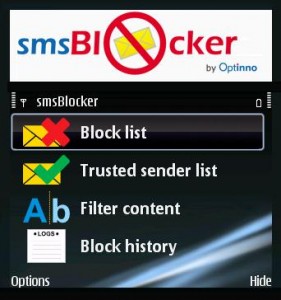
There are more than 650 million mobile phone users in India. While these devices help us connect to our family and friends, they also are culprit of many unwanted messages from spammers. Don't you get annoyed and irritated when you are expecting an important message, your phone buzzes, you check the phone and realize that it's a spam message? Sparing you the agony of spam messages is smsBlocker, an application that gives the user freedom from annoying spam and unwanted SMS.Developed by Optinno Mobitech, a Pune-based startup, smsBlocker identifies and blocks spam SMS on its own. It blocks over 95 percent of spam SMS automatically.
Sagar Bedmutha, a mechanical engineer by qualification, was leading a comfortable life with a swish job in HSBC Bank. He, like many others, was irritated with the constant spam messages. He quit his job in HSBC, and set out to address the problem of spam SMS. He founded the company Optinno Mobitech which was responsible for the innovation of smsBlocker. "The messages were analyzed on the basis of content, sender and language to decide on the pattern of spam messages like Hinglish and others," he says.The application is easy to set-up and integrates easily with your inbox and phonebook. It is fully customizable to suit your needs and preferences of who you want to block and not. There is a 'Daily Block Counter' on the phone homescreen that lets the user know how many spams were blocked in a particular day. The user can specify his 'Block list' and filter the messages based on the content and sender. A detailed log of all blocked SMSes is maintained which the user can review and also restore if need arises.
Subscribe to:
Posts (Atom)